| |
“ |
| No man ever steps in the same river twice, for it is not the same river and he is not the same man. |
| Heraclitus |
|
|
| October 6, 2026 |
Forget Elon, the real Tony Stark is Palmer Luckey |
| A billionaire in a sharp suit stands in the Afghan desert with a drink in his hand and a row of generals waiting on him. |
| He pushes a button and a missile called Jericho flattens a hillside behind him. The US military gets its chequebook out. |
| Today, that could be Secretary of War, Pete Hegseth. Or it could be Elon Musk. |
| But in 2008, it was the fictional comic book character, Tony Stark in the first act of blockbuster movie, Iron Man. |
 |
| Source: Screenrant |
| It’s funny how life imitates art... |
| And many suggest that today, Elon Musk is the real Stark. Robert Downey Jr even toured SpaceX with Musk while he got ready for the role. And Elon did cameo in Iron Man 2... |
| But Elon isn’t the modern iteration of Tony Stark. They’ve got the wrong guy. |
From garage VR to battlefield AR |
| At 17, Palmer Luckey built his first virtual reality headset in his parents’ garage in Long Beach, California. |
| He founded Oculus in April 2012 and raised $2.4 million on Kickstarter. Two years later, Mark Zuckerberg came knocking and Facebook bought it in 2014 for $2 billion, when Luckey was just 21. |
| Less than three years later Luckey got pushed out, some say because of his pretty staunch Republican views and fondness of newly elected President Trump. |
| So, what do you do when you’re in your 20s, a few billion to your name, and some mates deeply entrenched in the US administration? |
| Build a next-generation military tech company of course. |
| And that’s exactly what Luckey did. |
| By June 2017, months after his Facebook exit, he’d started Anduril, which builds drones, sensor towers, battlefield augmented reality, autonomous submarines, mass production missiles, and the AI-based software that ties them together... |
| And then, fortunately his favourite President gets a second term, and he suddenly at the top of the pecking order, his military tech companies is growing and developing new tech at an exponential rate, and even old pal Zuck who pushed you out almost a decade earlier is now one of the President’s new best mates. |
| While I’m sure there will be a documentary or streaming series in the works, the wild thing about all this is that now, at the ripe old age of 34, Luckey is sat at the head of a new US Department of War project, codenamed Meridan to lead the development of the next generation of US advanced military technology. |
| Talk about a fun ride! |
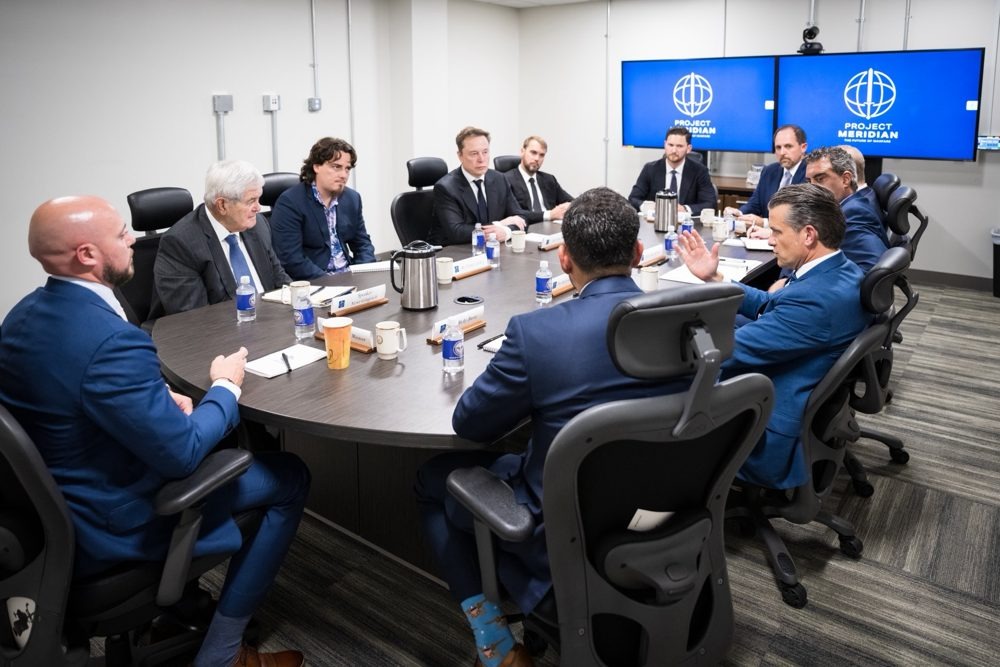
| Last Wednesday at Marine Corps Base Quantico, Secretary Hegseth named three people to co-lead Project Meridian, a 120-day study of what the Pentagon needs to win the next war. |
| Musk was one and Newt Gingrich was another. |
| The third, the most important and sat right between the others, was Luckey. |
 |
| Source: US Department of War via X.com |